General Atomics Advances Space-Based Weather Intelligence Mission to Improve All-Domain Tactical Decision-Making and Resilience
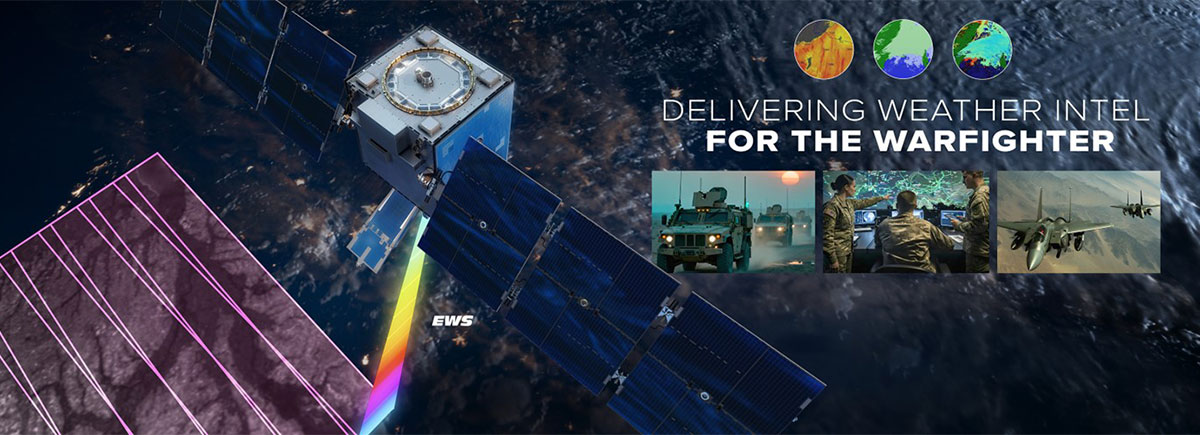
SAN DIEGO (April 14, 2026) — General Atomics Electromagnetic Systems (GA-EMS) completed the pre-ship review (PSR) for its advanced electro-optical/infrared (EO/IR) payload supporting the U.S. Space Force Space Systems Command’s EO/IR Weather System (EWS) program, clearing the payload for spacecraft integration and positioning the company as a prime contractor delivering end-to-end space mission capabilities. The payload closes the two highest-priority Space-based Environmental Monitoring capability gaps identified by the Joint Requirements Oversight Council: cloud characterization and theater weather imagery.
The EWS mission replaces the EO/IR capability of the aging Defense Meteorological Satellite Program (DMSP) and supports Department of War efforts to modernize legacy weather space architectures for cost efficiency. The system will deliver real-time weather imagery and advanced environmental intelligence to support mission planning, optimize flight operations, and enable joint force execution for theater of operations.
“Completing the pre-ship review demonstrates our advanced EO/IR payload’s readiness for spacecraft integration and marks a major step forward for the EWS mission. This U.S.‑designed and U.S.‑built capability will deliver the real‑time terrestrial environmental intelligence the joint force depends on for mission execution,” Scott Forney, president of GA‑EMS said.
The EO/IR payload provides 16 spectral bands, including a high-resolution ultra-low-light day/night sensor, a significant improvement over the two main spectral bands provided by the DMSP satellites. This expanded spectral coverage delivers unprecedented atmospheric and surface observations, enabling more accurate weather forecasting, improved threat detection, and enhanced mission planning across all domains. The payload integrates advanced optical performance with a compact, modular architecture designed for affordability and scalable production, delivering legacy capability in a significantly smaller and lower-cost form factor, a critical advantage for the Space Force’s disaggregated constellation strategy.
“This achievement showcases our ability to deliver innovative, agile solutions that adapt to evolving military requirements. GA-EMS creates the environmental intelligence layer that underpins modern joint operations and delivers expertise across the full spectrum of space mission execution, from payload design and spacecraft integration to on-orbit operations and data delivery,” Klaus Etzel, vice president of GA‑EMS Remote Space Sensing Systems said.
Completion of the PSR validates the payload’s design through rigorous functional, environmental qualification testing and calibration. The payload will ship from Acton, Mass., where GA‑EMS designed and manufactured the system, to the company’s facility in Centennial, Colo., for integration with its GA‑500 spacecraft bus. As prime contractor, GA‑EMS leads all aspects of the EWS satellite design, production, mission operations and data distribution. Following launch, the company will conduct on‑orbit calibration, collect sensor data, generate data products for the weather centrals and deliver actionable information directly to warfighters and mission planners.
About General Atomics Electromagnetic Systems
General Atomics Electromagnetic Systems (GA-EMS) develops innovative technologies to create breakthrough solutions supporting operational environments from undersea to space. From electromagnetic, power generation and energy storage systems and space systems and satellites, to hypersonic, missile defense, and laser weapon systems, GA-EMS offers an expanding portfolio of capabilities for defense, government, and national security customers. GA-EMS also provides commercial products and services targeting hazardous waste remediation, oil and gas, and nuclear energy industries. For further information, visit ga.com/EMS.
Media Inquiries EMS-MediaRelations@ga.com.