General Atomics Scientists Win Dawson Award, Help Prove a New Path Toward Fusion Energy
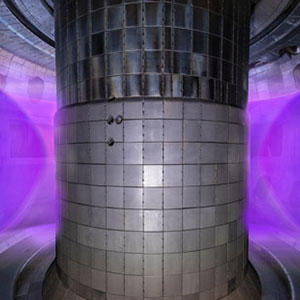
Inside a tokamak, powerful magnetic fields are used to shape and control superheated plasma so fusion reactions can take place.
As a major energy research and development firm, General Atomics’ energy businesses are often the subject of media coverage. We also engage in a variety of outreach efforts to the scientific and academic communities to educate the public on the future of energy. Media professionals seeking more information on these activities should contact Communications Lead Andrew James.
Inside a tokamak, powerful magnetic fields are used to shape and control superheated plasma so fusion reactions can take place.
America has spent decades searching for a better answer to one of nuclear energy’s toughest questions: what to do with used nuclear fuel that can remain hazardous for thousands of years. Now, General Atomics (GA) is taking on a lead industrial role in a collaborative project to develop technology that could make large-scale nuclear waste processing more practical and affordable in the United States.
SB 925 directs the California Energy Commission to develop a statewide strategy for advancing fusion research, bringing the technology to market, and creating a clearer path for siting and constructing future facilities.
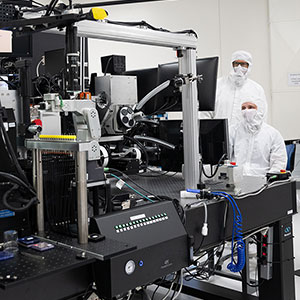
Scientists at General Atomics this month unveiled EXCALIBUR, a versatile new laboratory system designed to precisely measure and fine‑tune X‑ray equipment for advanced research and manufacturing.
(June 22, 2026) — General Atomics (GA) announced today it has been awarded a $20 million California Competes Tax Credit from the state of California through the Governor’s Office of Business and Economic Development (GO-Biz). The award will support the company’s proposal to design and develop a Blanket Component Test Facility (BCTF) in San Diego.
General Atomics (GA) announced today that the company is collaborating with the U.S. Department of Energy (DOE) to develop design concepts for a facility dedicated to testing full-scale fusion power-plant “blankets,” a critical system that has never been tested at this scale.
U.S. Secretary of Energy Chris Wright, Under Secretary for Science Darío Gil, and ARPA-E Director Conner Prochaska visited General Atomics (GA) this week to tour its fusion research and engineering facilities, highlighting work underway in San Diego to support U.S. national security and advance commercial fusion energy.
General Atomics Electromagnetic Systems (GA-EMS) and Entergy have signed a Memorandum of Understanding (MOU) to accelerate implementation of the GA-EMS’ SiGA® silicon carbide (SiC) composite nuclear fuel rod cladding by acquiring irradiation data in a commercial light water nuclear reactor.
A senior scientist at General Atomics has earned national recognition for helping to shape the way fusion devices are operated worldwide. Adrianus “George” Sips, senior director at General Atomics, was honored recently by the American Physical Society Division of Plasma Physics for his contributions to fusion science, particularly his pioneering work in tokamak scenario development.
More than 200 leaders from science, government, industry, and academia gathered today to accelerate California’s growing role as the nation’s top fusion energy hub. The event, called Accelerating California’s Fusion Energy Economy, marks California’s first statewide convening dedicated to advancing research, development, demonstration, and deployment of fusion energy.
This month marks a defining moment for California and the future of clean energy. With the signing of Senate Bill 80 (SB80), the state has made a bold commitment to accelerate the development of fusion—the same process that powers the sun—and to lead the nation in meeting America’s growing energy demands.
Researchers at General Atomics (GA) are lending their expertise to address one of fusion energy’s greatest challenges: sustaining the fuel that powers fusion reactions.
According to the report, available at fusionCA.org, California’s fusion industry could generate more than $125B in economic impact and support up to 43,000 jobs over the next decade.
This significant milestone underscores the ingenuity of California’s fusion engineering community, particularly in San Diego, and marks a major U.S. contribution to one of the most ambitious energy science projects in history.
This landmark collaboration will accelerate the development of UNITY-2, a cutting-edge tritium fuel cycle test facility poised to play a pivotal role in clearing the path towards commercializing fusion energy.
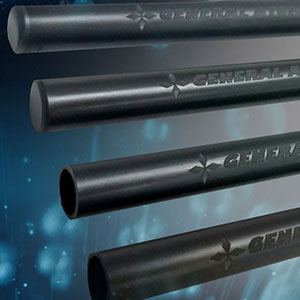
Engineers at General Atomics (GA) have reached a key milestone, completing the final shipment of critical corrugated waveguide components to the United Kingdom Atomic Energy Authority’s (UKAEA) Culham Campus. The delivery supports an upgrade to the Mega Ampere Spherical Tokamak (MAST) Upgrade machine, a next-generation fusion experiment that will soon test the novel plasma heating method called Electron Bernstein Wave (EBW) heating.
“With our long history of fusion innovation, General Atomics offers a powerful launchpad for fast-moving startups like Pacific Fusion,” said Dr. Anantha Krishnan, senior vice president of the General Atomics Energy Group.
Scientists and engineers at General Atomics (GA) and the University of California San Diego (UC San Diego) have announced a groundbreaking collaboration to establish a Fusion Data Science and Digital Engineering Center in San Diego.
Scientists at General Atomics (GA) are delighted this week after receiving funding from the U.S. Department of Energy (DOE) for important fusion energy research.
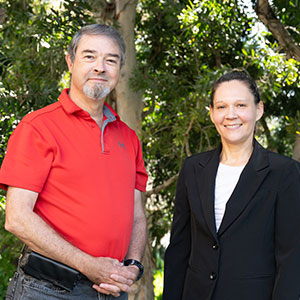
Two of San Diego’s leading fusion researchers have been awarded 2024 Fellowships by the American Physical Society (APS), the principal physics organization in the United States and one of the largest worldwide.
For almost 35 years, General Atomics (GA) scientists in San Diego have collaborated with the U.S. government to enhance homeland defense and advance fusion technology.
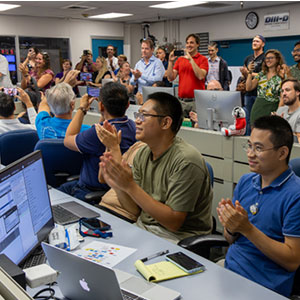
The DIII-D National Fusion Facility recently surpassed its 200,000th experimental cycle since it began operations, marking an important milestone in the development of clean fusion energy.
Scientists and researchers have long hailed fusion, the process that powers the sun, as a clean and virtually limitless energy source they can harness on earth.
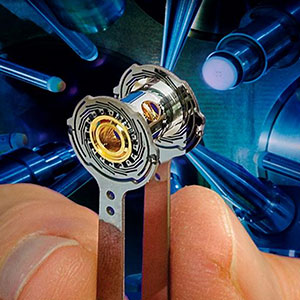
Scientists and engineers at General Atomics (GA) in San Diego are celebrating this week after members of their inertial fusion technologies team received some remarkable news about their work in creating technology that helped achieve the first controlled fusion “ignitions” in history.
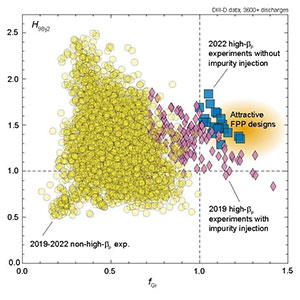
A team led by scientists from General Atomics (GA) has demonstrated, for the first time, an operational approach that is key to many tokamak-based fusion power plant (FPP) designs aiming to generate economically attractive electricity.